 APREX · EST. 2026
26 days. That's all it took. While traditional pharmaceutical giants spend four years and hundreds of millions of dollars identifying a single promising molecular candidate, Insilico Medicine put an AI to work — and got an answer in under a month. This isn't the future. It's happening right now, and it's sending shockwaves through an industry that hasn't fundamentally changed in decades.
AI vs. Traditional Drug Development
| Phase | Traditional Method | AI-Assisted Method |
|---|---|---|
| Molecule design | 3–5 years | Weeks to months |
| Cost per approved molecule | ~$2.6 billion | Estimated dramatic reduction |
| Phase I success rate | 40–65% | 80–90% |
| Time to Phase II | ~4 years | Under 18 months |
| Protein structures predicted | Limited manually | 230+ million (AlphaFold) |
From Impossible to Inevitable
ISM001-055 — known clinically as rentosertib — is an AI-designed molecule targeting idiopathic pulmonary fibrosis, a disease that progressively destroys lung tissue and has limited treatment options. According to Drug Discovery News, the candidate moved from design to Phase II clinical trials in under 18 months. The same journey typically takes four years by conventional methods.
In late 2025, rentosertib was described as the first AI-derived therapy to reach FDA-approved Phase II status for idiopathic pulmonary fibrosis. It's a milestone the industry has anticipated for years.
> "26 days to design a molecule that could save lives. The traditional industry spent four years on the same step."
The Brain Behind It: AlphaFold and the New Toolkit
You can't understand the revolution without understanding AlphaFold. DeepMind's protein structure AI won the Nobel Prize in Chemistry in October 2024, awarded to Demis Hassabis, John Jumper, and David Baker. The system can predict three-dimensional structures of proteins with over 90% accuracy — a task that previously required years of X-ray crystallography and manual interpretation.
The AlphaFold database now contains over 230 million predicted structures and is used by more than three million researchers in over 190 countries, according to open primary sources from DeepMind.
In May 2024, AlphaFold 3 was launched with improved ability to predict how drugs bind to proteins — the so-called protein-ligand interaction problem, which is critical for drug design.
Then, in February 2026, Isomorphic Labs — an Alphabet and DeepMind spinoff founded in 2021 — released a new platform called IsoDDE. According to analysis from presenc.ai and blockchain.news, IsoDDE doubles the accuracy of AlphaFold 3 on the hardest ligand cases: approximately 50% accuracy versus the previous 23.3%.
KEYFIGURE
$9.1 billion — estimated market value for AI drug design by 2032
230+ million — protein structures in the AlphaFold database
80–90% — Phase I success rate for AI-designed molecules
26 days — time it took AI to design rentosertib against lung disease
The Billion-Dollar Race
Isomorphic Labs is not alone. An entire ecosystem of companies is competing to become the AI infrastructure of the pharmaceutical industry.
Isomorphic Labs itself has secured partnerships with Eli Lilly and Novartis worth up to three billion dollars, and raised over $600 million in new funding in March 2025 led by Thrive Capital, according to wifitalents.com. The company's first fully AI-designed drug candidate is planned for first-in-human trials by the end of 2026 — delayed from the original 2025 target.
Other major players include Recursion (NYSE-listed), Xaira Therapeutics with over one billion dollars in funding, and Generate:Biomedicines, which has a one-billion-dollar partnership with Novartis. Venture capital poured $3.3 billion into the sector in 2024 alone.
Analysis firms estimate that AI could deliver a combined value of $350 to $410 billion annually to the pharmaceutical industry.
HIGHLIGHT
ESM-3: When AI Designs Life from Scratch
In June 2024, EvolutionaryScale launched ESM-3, a multimodal protein language model that doesn't just predict protein structures — it generates entirely new ones. The model designed a variant of the green fluorescent protein (GFP) with an estimated 500 million years of evolutionary distance from known natural variants. No natural evolution has produced anything like it. It's a demonstration that AI can now move into biology's most creative territory.
The FDA Wakes Up — Without Hitting the Brakes
The FDA completed its first AI-assisted scientific review in 2025 and has deployed an internal tool called "Elsa" to evaluate safety information in submitted documents, according to genhealthconsult.ai.
In 2025, the FDA also published draft guidance for AI in drug development — a risk-based framework requiring model transparency, validation, and data governance. The message is clear: regulators won't slow innovation, but they will demand to know exactly how the machines think.
FACTBOX: The Challenges AI Hasn't Solved Yet
- Synthesizability: Many AI-designed molecules are chemically elegant on paper but difficult or impossible to produce in the lab
- Clinical complexity: Even with higher Phase I success rates, human biology remains unpredictable. Phase II and III trials are not automatic successes
- Data bias: AI models are only as good as the data they're trained on. Historical drug data may contain biases that get replicated and amplified
- Explainability: Why did the AI recommend this particular molecule? The answer isn't always transparent — creating challenges for regulatory approval
- IP questions: Who owns the patent on a drug designed by a machine?
The Next Step: AI as Independent Researcher
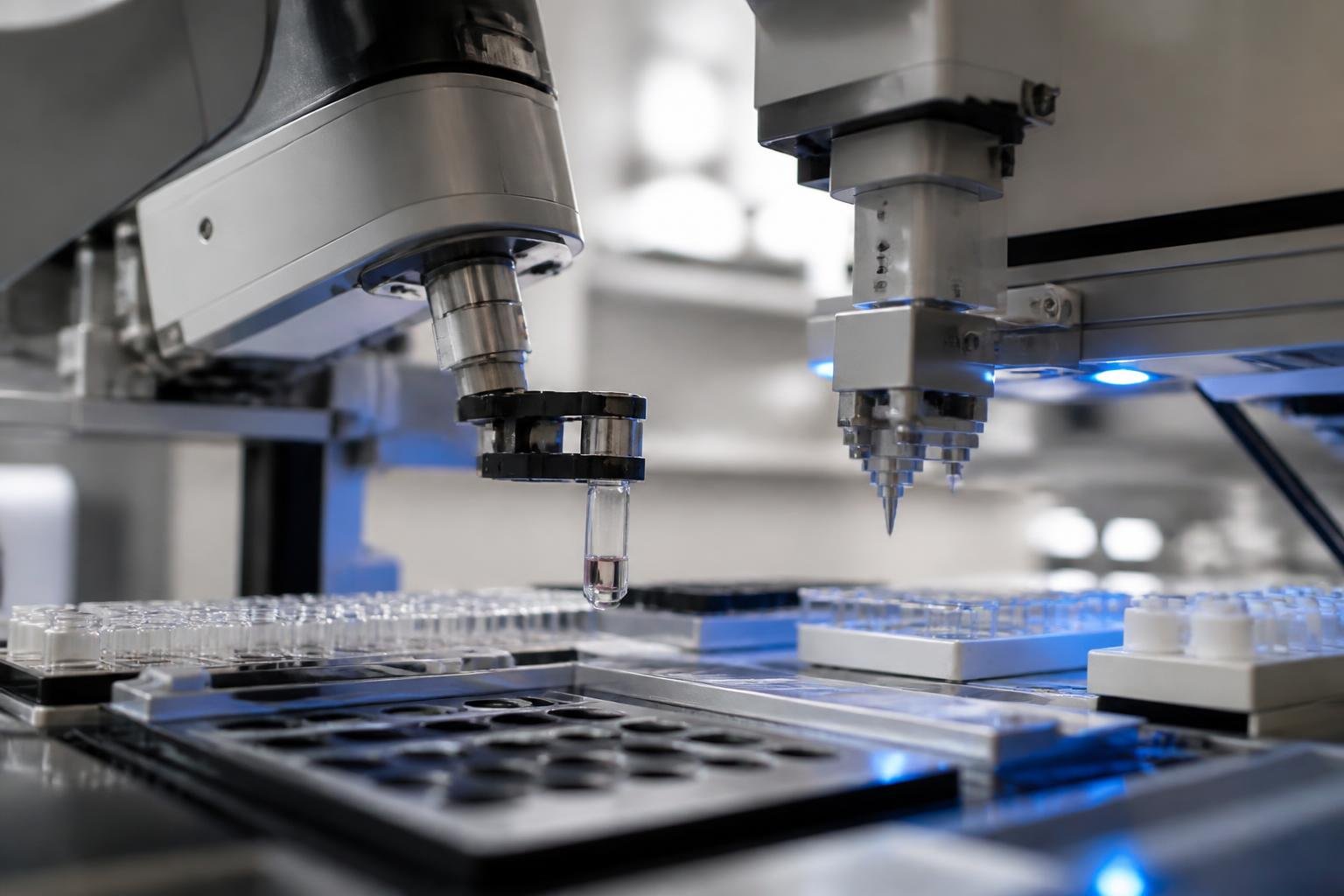
What is now being called "Agentic Discovery" points toward a near future where AI systems don't just recommend molecules — they design experiments, order reagents, run them on robotic platforms, and iterate based on results. A closed loop without human involvement in the daily cycle.
The timeline from concept to clinic, already compressed from 12–15 years to potentially 3–5 years, could shrink further. The question is no longer whether AI will transform the drug industry — but how fast.
BOTTOM LINE
26 days versus four years. 80–90% versus 40–65%. These numbers tell a simple story: AI-driven drug design is not a promising hypothesis — it is a technology already delivering clinical results. Rentosertib is in human trials. Isomorphic Labs is ready to send its first fully AI-designed candidate into the human body. The FDA is adapting. The money is flowing. The pharmaceutical industry's slowest phase is becoming its fastest.
Verified against 10 open primary sources.