 APREX · EST. 2026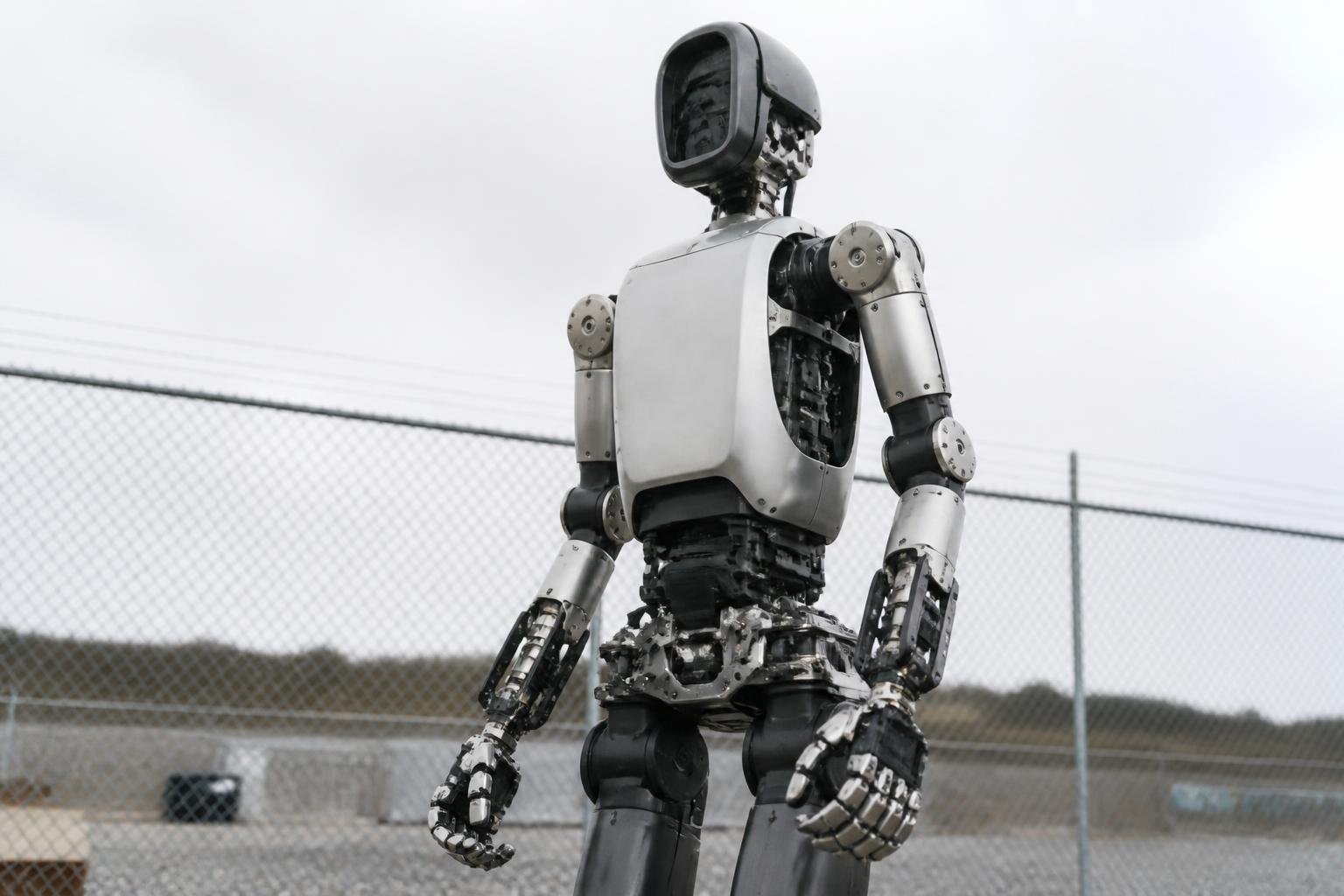
A little-known San Francisco startup is positioning itself at the intersection of artificial intelligence, robotics, and military power. Foundation Future Industries, founded in April 2024, has rapidly secured multimillion-dollar contracts with the U.S. military and carried out what is described as the first-ever deployment of humanoid robots in an active combat zone.
Phantom MK-1: A Robot Built for War
The company's flagship model, the Phantom MK-1, is designed to look and move like a human being. The robot stands 175 centimeters tall, weighs around 80 kilograms, and features 19 degrees of freedom in its upper body, five-fingered hands, and a camera system as its primary sense. It is powered by an autonomy stack based on large language models (LLMs), can carry nearly 40 kilograms, and walks at speeds of up to 6.4 kilometers per hour, according to company information cited by Wired.
CEO Sankaet Pathak has told Wired that he envisions robots taking over the most dangerous roles in warfare, framing it as a moral obligation to send machines into combat rather than soldiers. The company is exploring what Pathak calls "kinetic tasks" — a military euphemism covering everything from logistics to direct combat.
"There is a moral obligation to send these robots to war instead of soldiers" — Sankaet Pathak, CEO of Foundation Future Industries
Co-founder Mike LeBlanc is a 14-year U.S. Marine Corps veteran who lends military credibility to the project.
Ukraine as a Testing Ground
In February 2026, two units of the Phantom MK-1 were sent to Ukraine for front-line testing, with a focus on logistics and reconnaissance. According to Wired, this marks the first documented deployment of humanoid robots in an active combat zone.
The company has also signed contracts worth $24 million with the U.S. Army, Navy, and Air Force, under which the robots will be tested in scenarios including breaching enemy positions, inspecting and transporting weapons, and what are described as "surgical operations" — such as extracting a target.
Politically Charged Connections
The company's chief strategy officer is none other than Eric Trump, son of the U.S. president. The association has already sparked political controversy. Senator Elizabeth Warren has publicly characterized the Pentagon contracts as "corruption in plain sight," according to Wired.
This is also not the first time CEO Pathak has found himself in troubled waters. He previously led the payments platform Synapse, which went bankrupt in 2024 with millions in consumer funds left in limbo.
Technical and Ethical Hurdles
The company is candid about the fact that its most advanced combat capabilities are "years away." Humanoid robots continue to struggle with durability, cost, and reliability in unpredictable environments. Where existing military robots — wheeled, tracked, or quadrupedal — succeed because they are simple and inexpensive, a single Phantom unit is estimated to cost around $150,000 and can fall on uneven terrain.
The company stresses that any use of lethal force will in any case require human authorization, analogous to how military drones operate today. But ethics researchers and weapons experts warn that the line between human control and machine autonomy can quickly blur in chaotic combat scenarios — an issue the United Nations and international organizations have debated intensely in recent years without reaching binding regulations.
Ambitions That Outpace Today's Reality
The production targets are staggering: 40 units in 2025, 10,000 in 2026, and 50,000 by the end of 2027. The company is now seeking $500 million in new capital at a valuation exceeding three billion dollars. Whether these ambitions can be realized — technically, financially, and politically — remains to be seen. But the fact that humanoid robots have now actually been deployed in an active war zone is no longer the stuff of science fiction.