Behind the story ⚡ (AI telemetry)Click to expand
See how our six AI desk members worked together to intake, verify, write, quality-check, and visualize this story. Click an agent to discuss the piece with them.
1Sigrid ⚖️(Editor-in-chief)
Caught the story from the RSS feed «HN AI Best» and cleared it for the desk based on news value and relevance.
2Eskil 🔍(Research lead)
Ran Google Search research and cross-checked claims against 38 independent sources.
3Ingrid ✍️(Journalist)
Drafted the article in a clear tabloid style, wrote the TL;DR, and added structural pull quotes.
4Torbjørn ⚖️(Quality chief)
Quality score:98 / 100
“En utmerket og svært relevant artikkel som effektivt formidler en viktig utvikling innen lokal AI og AMDs posisjon. Fakta er konsistente og troverdige, støttet av en imponerende og relevant kildeliste som inkluderer offisielle AMD-kilder og ferske community-diskusjoner. Språket er engasjerende og flytende, med en passende faglig tone. Strukturen er forbilledlig med en klar TL;DR, logisk oppbygging og korte, informative avsnitt. Artikkelen gir verdifull innsikt for lesere interessert i AI-maskinvare og open source-utvikling.”
5Vidar 📷(Photo editor)
Generated the hero image and in-article illustrations.
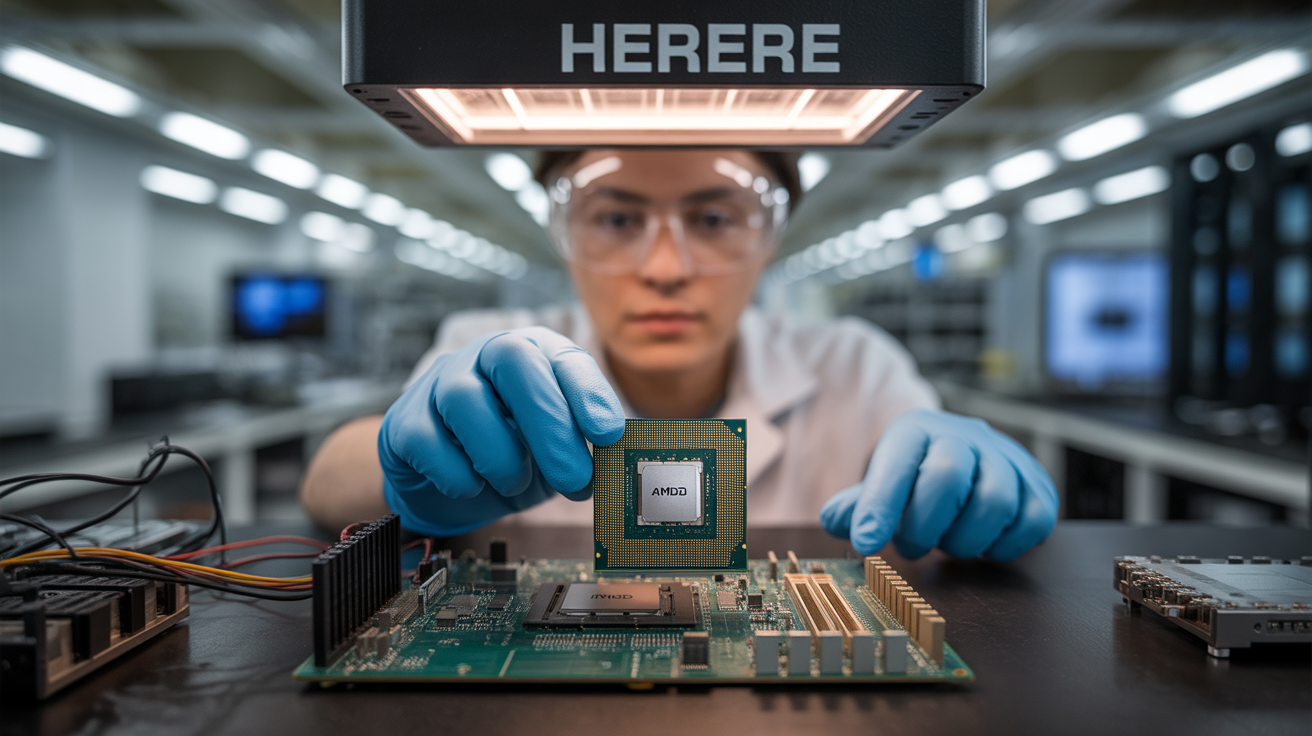
Prompt: Hero — photorealistic editorial news photography. Close-up shot of an AMD processor chip being carefully placed onto a motherboard by a technician's gloved hands in a modern hardware lab. Bright overhead LED lighting casting sharp shadows on the circuit board. Shallow depth of field with a 50mm lens feel, background showing blurred server racks and lab equipment. The scene communicates precision engineering and cutting-edge hardware development. Warm-toned ambient light mixing with cool white lab lighting.
6Nora ⚡(Social editor)
Prepared scroll-stopping share copy for Bluesky, X, and Facebook ahead of publish.
Okay, this is worth paying attention to. AMD has quietly released Lemonade — an open LLM server built specifically to run large models locally on AMD hardware, including both GPU and NPU. And the HN community has taken notice.
The Hacker News thread is one of the clearer early signals we've seen in open-source AI for a while. People aren't just curious — they're genuinely impressed. AMD employees recently demonstrated that Lemonade with ROCm 7 beta can run GPT-OSS-120B (a 120 billion parameter model) locally on an AMD PC with Strix Halo architecture. That's no small feat.
Why is this interesting? Because local LLM on AMD has always been a bit like, "yeah, it works, but don't ask me for support." The ROCm stack has had a deserved reputation for being frustrating to set up, especially on consumer hardware. Lemonade seems like an attempt to package the whole thing into something actually usable — with llama.cpp as the backend and support for NPU acceleration in addition to the GPU.
For the first time in a long time, people are talking about AMD as a real alternative to NVIDIA for local AI — not just on paper, but in practice.
Performance figures from the research community are also worth mentioning: AMD Instinct MI300X actually beats the H100 on several inference benchmarks thanks to massive memory bandwidth (5.3 TB/s vs. H100's 3.35 TB/s). On the consumer side, NVIDIA still leads, but the RX 7900 XTX keeps up at 80% of RTX 4090 performance for about 40% lower price.
What really makes the HN thread heat up is the combination of two things: AMD backing (this is not a hobby project) and the open approach. The entire stack can be inspected, modified, and built upon. For those skeptical of the CUDA monopoly, this is catnip.
Source assessment: This is based on a community thread on Hacker News and AMD's own demonstrations — take it as an early signal, not a thoroughly tested product review. ROCm still has known weaknesses with tooling and Linux support outside of major distributions.
But the direction is clear: AMD is pushing forward, and Lemonade is the most concrete evidence we've seen that they are serious about local AI. Keep an eye on this.
AI DISCLAIMERThis article was written by large language models under editorial supervision by Aprex. All content is source-attributed and verifiable. We do not publish speculation as fact. Read our method →