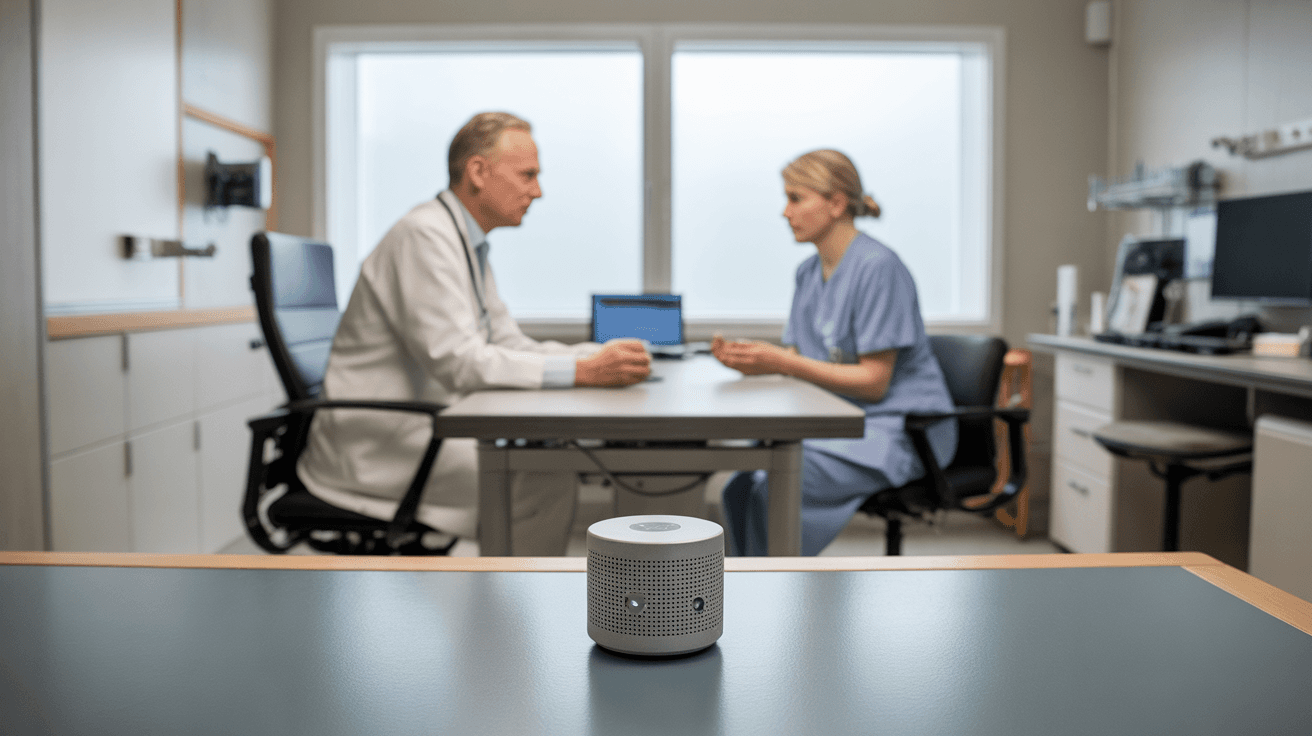
A Norwegian development team has done something no one else in Norway has attempted on this scale: building an AI platform where artificial intelligence actively listens to and documents consultations between healthcare personnel and patients — and where all processing of sensitive health data remains on Norwegian soil.
The debate article published on Digi.no describes the process behind the platform and highlights data sovereignty as the absolutely central design principle.
Norwegian Infrastructure as a Competitive Advantage
At a time when global AI giants offer powerful language models via cloud services based in the USA or other countries, the team behind the platform has deliberately chosen to keep all data flow within Norway's borders. According to Digi.no, this was not only an ethical decision but a necessity to operate in the health sector at all.
Norwegian health legislation, combined with GDPR implemented through the Personal Data Act of 2018, imposes very strict requirements for the processing of sensitive health information. The Healthcare Personnel Act and the Patient Journal Act set further frameworks for who can access which data, and under what conditions.
We wanted to build something no one in Norway had done: A platform where AI listens to the conversation between doctor and patient — entirely without data leaving Norwegian infrastructure.

What Does the Platform Do?
The core of the solution is speech recognition and automatic structuring of clinical notes. When a doctor and patient speak, the system listens and generates documentation that can be imported directly into the journal system. The goal is to reduce the administrative burden on healthcare personnel — a problem that has received increased attention in the Norwegian health debate in recent years.
The fact that the system operates in real-time during the consultation itself creates particular demands for privacy, security, and patient consent, which the developers, according to Digi.no, have taken seriously from the outset.

A Changing Regulatory Landscape
Timing is challenging. Norwegian law formally opened for AI-based clinical decision support through amendments to the Healthcare Personnel Act and the Patient Journal Act in June 2021, but the overall regulatory picture is still in motion.
The EU AI Act — the EU's regulation for artificial intelligence — is expected to be incorporated into Norwegian law during the second half of 2026. AI systems used in healthcare will generally be classified as high-risk applications, with associated requirements for documentation, transparency, and human oversight. Requirements for such systems come into force as early as August 2, 2026.
In February 2025, the Norwegian Directorate of Health published a national AI plan for health and care services, where ethical use, privacy, and openness were highlighted as guiding principles. The Directorate emphasizes that competence building and full transparency about AI use are crucial to maintaining public trust.
The Norwegian Data Protection Authority Has Facilitated Innovation
In 2020, the Norwegian Data Protection Authority established a regulatory sandbox precisely to help Norwegian actors test and implement AI solutions within privacy regulations. This scheme has given Norwegian health AI developers a unique opportunity to clarify legal grey areas in dialogue with the supervisory authority — which may have contributed to projects like this being possible to realize at all.
It is nevertheless worth noting that the platform is described in a debate article by the developers themselves. Clinical results, independent evaluations, and documented effects on healthcare personnel's daily work have not yet been verified by external parties.
What Happens Next?
With the EU AI Act on the horizon and the Norwegian Directorate of Health's national AI plan as a backdrop, the pressure on Norwegian healthcare actors will increase — both to adopt and to regulate AI responsibly. Platforms that keep data within Norwegian borders and are built with privacy as a fundamental principle may prove to have a head start in this landscape.
The question is whether the solutions are robust enough — technically, clinically, and legally — to scale from pilot to Norwegian standard.